junit4执行加载器默认为 BlockJUnit4ClassRunner,平时测试时我经常使用的是 SpringRunner、MockitoJUnitRunner、PowerMockRunner 等,具体使用方式为使用类注解@RunWith,本文中以默认加载器进行解读,其他几个常用 runner 后续进行单独解读。
Junit4 源码阅读
阅读方向:根据对 Junit4 的使用,首先是如何加载并运行测试,然后是一些常用注解
-
idea 调用入口
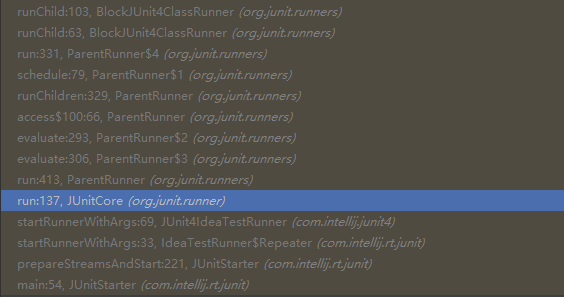 Figure 1. idea调用
可以看出
idea插件实际调用到了JUnitCore类的run方法,下文就直接从该方法开始往下阅读//创建一个RunNotifier对象以告知Junit执行测试的进展 private final RunNotifier notifier = new RunNotifier(); public Result run(Runner runner) { //创建result对象 Result result = new Result(); //创建RunListener RunListener listener = result.createListener();(1) //添加监听 notifier.addFirstListener(listener);(2) try { //初始化测试Description notifier.fireTestRunStarted(runner.getDescription());(3) //runner运行 runner.run(notifier);(4) //执行所有的监听器处理执行结果 notifier.fireTestRunFinished(result);(5) } finally { //移除监听 removeListener(listener);(6) } //返回结果 return result; }1 详见下文 createListener2 详见下文 addFirstListener3 详见下文 Description和fireTestRunStarted4 详见下文 runner.run5 详见下文 fireTestRunFinished6 详见下文 removeListener -
createListener
public RunListener createListener() { return new Listener(); } @RunListener.ThreadSafe private class Listener extends RunListener { //测试程序开始执行 @Override public void testRunStarted(Description description) throws Exception { startTime.set(System.currentTimeMillis()); } //测试程序执行完成 @Override public void testRunFinished(Result result) throws Exception { long endTime = System.currentTimeMillis(); runTime.addAndGet(endTime - startTime.get()); } //一个测试方法执行完成 @Override public void testFinished(Description description) throws Exception { count.getAndIncrement(); } //一个测试方法执行失败 @Override public void testFailure(Failure failure) throws Exception { failures.add(failure); } //一个测试方法执行忽略 @Override public void testIgnored(Description description) throws Exception { ignoreCount.getAndIncrement(); } //若测试方法因调用 Assume 类中的方法失败(这种失败不认为是测试失败),则会发布 testAssumptionFailure 事件 @Override public void testAssumptionFailure(Failure failure) { assumptionFailureCount.getAndIncrement(); } } -
addFirstListener
public void addFirstListener(RunListener listener) { //没有监听器则抛出异常 if (listener == null) { throw new NullPointerException("Cannot add a null listener"); } //添加第一个监听器 listeners.add(0, wrapIfNotThreadSafe(listener)); } RunListener wrapIfNotThreadSafe(RunListener listener) { //返回RunListener.ThreadSafe注解类的监听器对象 return listener.getClass().isAnnotationPresent(RunListener.ThreadSafe.class) ? listener : new SynchronizedRunListener(listener, this); } -
Description
runner.getDescription()public Description getDescription() { Class<?> clazz = getTestClass().getJavaClass(); Description description; // if subclass overrides `getName()` then we should use it // to maintain backwards compatibility with JUnit 4.12 if (clazz == null || !clazz.getName().equals(getName())) { description = Description.createSuiteDescription(getName(), getRunnerAnnotations()); } else { description = Description.createSuiteDescription(clazz, getRunnerAnnotations()); } //遍历所有@Test的方法 for (T child : getFilteredChildren()) { //测试类添加child(测试方法) description.addChild(describeChild(child)); } return description; }private Description(Class<?> testClass, String displayName, Serializable uniqueId, Annotation... annotations) { if ((displayName == null) || (displayName.length() == 0)) { throw new IllegalArgumentException( "The display name must not be empty."); } if ((uniqueId == null)) { throw new IllegalArgumentException( "The unique id must not be null."); } //测试类 this.fTestClass = testClass; //测试类名称 this.fDisplayName = displayName; //description唯一标识,默认为测试类名称 this.fUniqueId = uniqueId; //测试方法注解 this.fAnnotations = annotations; }private List<T> getFilteredChildren() { if (filteredChildren == null) { childrenLock.lock(); try { if (filteredChildren == null) { //获取所有的测试方法 filteredChildren = Collections.unmodifiableList( new ArrayList<T>(getChildren())); } } finally { childrenLock.unlock(); } } return filteredChildren; }getChildren最终会调用computeTestMethods
protected List<FrameworkMethod> computeTestMethods() {
    //返回所有@Test注解的方法
    return getTestClass().getAnnotatedMethods(Test.class);
}
private final ConcurrentMap<FrameworkMethod, Description> methodDescriptions = new ConcurrentHashMap<FrameworkMethod, Description>(); protected Description describeChild(FrameworkMethod method) { //获取方法对应的description Description description = methodDescriptions.get(method); if (description == null) { description = Description.createTestDescription(getTestClass().getJavaClass(), testName(method), method.getAnnotations()); //添加method对应的description methodDescriptions.putIfAbsent(method, description); } //返回方法对应的description return description; } -
fireTestRunStarted
public void fireTestRunStarted(final Description description) { //开启监听器 new SafeNotifier() { @Override protected void notifyListener(RunListener each) throws Exception { //将测试类description传入所有监听器 each.testRunStarted(description); } }.run(); } -
runner.run
public void run(final RunNotifier notifier) {
        //创建EachTestNotifier对象
        EachTestNotifier testNotifier = new EachTestNotifier(notifier,
                getDescription());
        //测试套件开始执行调用
        testNotifier.fireTestSuiteStarted();
        try {
            //创建Statement对象,用于执行测试用例
            Statement statement = classBlock(notifier);
            //调用->withInterruptIsolation->childrenInvoker->runChildren->runChild->runLeaf->methodBlock(method).evaluate()-> testMethod.invokeExplosively(target)
            statement.evaluate();
        } catch (AssumptionViolatedException e) {
            //Assumption失败
            testNotifier.addFailedAssumption(e);
        } catch (StoppedByUserException e) {
            throw e;
        } catch (Throwable e) {
            testNotifier.addFailure(e);
        } finally {
            //testSuiteFinished测试套件执行完成
            testNotifier.fireTestSuiteFinished();
        }
    }
public void fireTestSuiteStarted(final Description description) { new SafeNotifier() { @Override protected void notifyListener(RunListener each) throws Exception { //监听器在测试套件开始执行时调用 each.testSuiteStarted(description); } }.run(); }protected Statement classBlock(final RunNotifier notifier) { Statement statement = childrenInvoker(notifier); //如果所有测试方法都是ignore为假,则进入 if (!areAllChildrenIgnored()) { //@BeforeClass statement = withBeforeClasses(statement); //@AfterClass statement = withAfterClasses(statement); //@ClassRule statement = withClassRules(statement); //在执行语句后清除当前线程的中断状态 statement = withInterruptIsolation(statement); } return statement; } protected Statement childrenInvoker(final RunNotifier notifier) { return new Statement() { @Override public void evaluate() { runChildren(notifier); } }; } private void runChildren(final RunNotifier notifier) { final RunnerScheduler currentScheduler = scheduler; try { //遍历所有需要执行的用例 for (final T each : getFilteredChildren()) { currentScheduler.schedule(new Runnable() { public void run() { //执行测试 ParentRunner.this.runChild(each, notifier); } }); } } finally { currentScheduler.finished(); } } private List<T> getFilteredChildren() { if (filteredChildren == null) { childrenLock.lock(); try { if (filteredChildren == null) { //getChildren即前面已经讲过的获取所有@Test方法,这里则是传入所有的child filteredChildren = Collections.unmodifiableList( new ArrayList<T>(getChildren())); } } finally { childrenLock.unlock(); } } return filteredChildren; } private volatile RunnerScheduler scheduler = new RunnerScheduler() { //run 传入的childStatement public void schedule(Runnable childStatement) { childStatement.run(); } public void finished() { // do nothing } };protected void runChild(final FrameworkMethod method, RunNotifier notifier) { //获取description Description description = describeChild(method); //如果@Ignore注解 if (isIgnored(method)) { //调用监听器testIgnored notifier.fireTestIgnored(description); } else { //不是ignore则创建Statement进行执行 Statement statement = new Statement() { @Override public void evaluate() throws Throwable { methodBlock(method).evaluate(); } }; //statement执行调用 runLeaf(statement, description, notifier); } } protected boolean isIgnored(FrameworkMethod child) { return child.getAnnotation(Ignore.class) != null; } public void fireTestIgnored(final Description description) { new SafeNotifier() { @Override protected void notifyListener(RunListener each) throws Exception { //监听器testIgnored each.testIgnored(description); } }.run(); }protected Statement methodBlock(final FrameworkMethod method) { Object test; try { //创建测试类实例 test = new ReflectiveCallable() { @Override protected Object runReflectiveCall() throws Throwable { return createTest(method); } }.run(); } catch (Throwable e) { return new Fail(e); } Statement statement = methodInvoker(method, test); //@Test(expected = ?) statement = possiblyExpectingExceptions(method, test, statement); //@Test(timeout=?) statement = withPotentialTimeout(method, test, statement); //@Before statement = withBefores(method, test, statement); //@After statement = withAfters(method, test, statement); //@Rule statement = withRules(method, test, statement); //在执行语句后清除当前线程的中断状态 statement = withInterruptIsolation(statement); return statement; }protected final void runLeaf(Statement statement, Description description, RunNotifier notifier) { EachTestNotifier eachNotifier = new EachTestNotifier(notifier, description); //调用监听器执行testStarted eachNotifier.fireTestStarted(); try { //测试执行 statement.evaluate(); } catch (AssumptionViolatedException e) { //调用Assumption失败 eachNotifier.addFailedAssumption(e); } catch (Throwable e) { //Throwable eachNotifier.addFailure(e); } finally { //testFinished eachNotifier.fireTestFinished(); } } -
fireTestRunFinished
public void fireTestRunFinished(final Result result) { new SafeNotifier() { @Override protected void notifyListener(RunListener each) throws Exception { //监听器处理结果信息 each.testRunFinished(result); } }.run(); } -
removeListener
public void removeListener(RunListener listener) {
    //移除监听
    notifier.removeListener(listener);
}
测试方法执行顺序
在之前的版本中,Junit在设计上并没有指定测试方法的执行顺序,从4.11版本开始,Junit将默认使用一种确定性的顺序,也即 MethodSorters.DEFAULT。如果想改变测试方法的执行顺序可以为测试用例添加 FixMethodOrder 注解,并且指定其方法的排序类型,可选的 MethodSorters 有:
-
DEFAULT,根据方法名称的hashCode进行比较,如果hashCode相同则按照NAME_ASCENDING进行比较; -
NAME_ASCENDING,根据方法名称进行比较; -
JVM,使用JVM返回的顺序。
/**
 * Sort the methods into a specified execution order.
 * Defines common {@link MethodSorter} implementations.
 *
 * @since 4.11
 */
public enum MethodSorters {
    /**
     * Sorts the test methods by the method name, in lexicographic order,
     * with {@link Method#toString()} used as a tiebreaker
     */
    NAME_ASCENDING(MethodSorter.NAME_ASCENDING),

    /**
     * Leaves the test methods in the order returned by the JVM.
     * Note that the order from the JVM may vary from run to run
     */
    JVM(null),

    /**
     * Sorts the test methods in a deterministic, but not predictable, order
     */
    DEFAULT(MethodSorter.DEFAULT);

    private final Comparator<Method> comparator;

    private MethodSorters(Comparator<Method> comparator) {
        this.comparator = comparator;
    }

    public Comparator<Method> getComparator() {
        return comparator;
    }
如果一定需要按照自定义顺序执行,可以使用 TestNG 测试框架进行 case 顺序定义,后续会在 TestNg 源码阅读博客中进行讲述。
总结
类说明
-
BlockJUnit4ClassRunner
继承ParentRunner,实现了ParentRunner的runChild(真正执行测试的方法,每个测试方法都会执行runChild)。describeChild(FrameworkMethod method)(用来获取测试类的元数据信息,以及方法和类的信息),一些验证的方法,这些验证方法在ParentRunner构造的时候就会开始验证。methodBlock(FrameworkMethod method)method里面包含当前要测试的方法。这个方法的作用验证方法能否执行,然后把当前测试类的信息(当前类,测试的方法)传给InvokeMethod,以待后续测试方法的执行,接着获取当前类的元数据信息,保存起来。 -
ParentRunner
Junit4测试执行器的基类,它提供了一个测试器所需要的大部分功能。 -
Statement
在运行期时,执行test case前可以插入一些用户动作,它就是描述这些动作的一个类。 -
TestRule
TestRule可以描述一个或多个测试方法如何运行和报告信息的接口。在TestRule中可以额外加入一些check,我们可以让一个test case失败/成功,也可以加入一些setup和cleanup要做的事,也可以加入一些log之类的报告信息。总之,跑test case之前的任何事,都可以在里面做。需要实现apply()方法。 -
Description
存储着当前单个或多个test case的描述信息。这些信息跟逻辑不关,比如元数据信息等。实例化Description用Description.createTestDescription()方法。 -
RunNotifier
运行时通知器。执行Runner.run(RunNotifier runNotifier)方法时,需要传一个RunNotifier进去,这个RunNotifier是事件的管理器,它能帮助我们监控测试执行的情况。 -
InvokeMethod
最终执行test case里面的测试方法通过这个类来做,这个类会间接调用Method.invoke()方法通知编译器执行@test方法。